
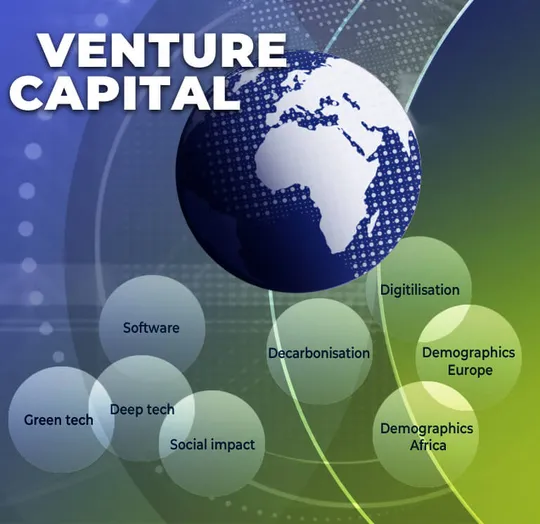
Venture capital for technology-driven sustainability
Supporting selected venture capital fund managers and technology businesses in Western Europe and Africa with patient and purposeful capital in the areas of digitalisation, decarbonisation and social and environmental impact.

About
Peter Cullom
I have been working in Private Equity and Venture Capital for over 30 years and through four significant business cycles of growth and recession.
Growing up in the UK, I have lived and worked in Germany, Belgium, Luxembourg and South Africa. After four years as a telco sales rep in Germany and an MBA in Belgium, I worked for Price Waterhouse for nine years as an auditor and corporate finance advisor. In my private equity career from 1993 I ran the Frankfurt investment office of 3i Group, was a partner at buyout firm ECM in Frankfurt and worked with Investec Africa Private Equity in Cape Town and London, now part of The Rohatyn Group.

Digitalisation
The future of work
Private and public sectors are increasingly automating their internal processes and procedures and developing new digital services and business models. The Covid-19 pandemic significantly accelerated this development, and artificial intelligence is now accelerating it further.
There are huge opportunities for venture capital to disrupt and make more efficient the way we learn, work, travel, live, finance, organise and care for ourselves. Think of automation (including robotics, artificial intelligence and machine learning), connectivity (including 5G, smart sensors and the internet of things), remote working, fintech, edtech, healthtech, agritech, e-commerce, e-mobility, e-government, 3D printing, blockchain, quantum computing etc.
DECARBONISATION
The future of the environment
Current policies put the world on course for around 2.8 °C of warming by 2100, and the 1.5 °C limit is likely to be exceeded within the next decade. Every tenth of a degree avoided reduces the risk of catastrophic water scarcity, extreme heatwaves, reduction of crop yields, acidification of the oceans, rising sea levels, climate-induced poverty and migration flows and overall economic decline.
The move from almost 58 billion tons of greenhouse gas emissions a year to a net-zero carbon economy by 2050 is a huge and historic challenge. This transformation can be significantly accelerated by venture capital financed innovation in producing and storing green (carbon-free) electricity and radically rethinking how we manufacture and consume things, how we grow and treat our food and how we move and travel around.
Climate change and human-induced habitat destruction are causing unprecedented losses of plant, insect, animal and bacterial life. Biodiversity loss and its effect on the environment is the other historic challenge of the 21st century. Here too, venture capital is playing a part in understanding the immensity of the problem and providing solutions.

Demographics Europe
The future of the family
The working age population of Europe will decrease significantly.
Many more Europeans will spend their last 10-20 years coping with illness as the population over 65 doubles and the average life expectancy reaches 90+. The care and medical market is inefficient and costly. Agetech, healthtech and biotech offer considerable opportunities for venture capital to help rethink the whole concept of care, medicine and medical provision.
Society has in the past inadequately addressed the challenges arising from poverty, inequality, differences in race, gender, origins and mental and physical abilities. Venture capital impact funds are starting to provide new opportunities and technologies for the disadvantaged.
Demographics Africa
The future of Africa
Africa’s population under the age of 25 amounts to 60% (Europe 27%) making Africa with a median age of 19 (Europe 43) the world’s youngest continent. Africa will account for all of the world’s net population growth until 2100, increasing its population about 2.5x from 1.5 to 3.8 billion. Currently, too much political instability, ethnic strife, corruption, discrimination, inadequate infrastructure and poor education cause widespread inequality, poverty and hunger. Small businesses, both urban and rural, suffer from poor access to finance and no or irregular electricity.
However, the growing ranks of the educated young think in innovative risk-taking ways and quickly adopt and adapt the newest technologies. Young entrepreneurs are the gateway to higher prosperity in Africa. World-leading developments in fintech, edtech, agritech, healthtech and solar energy are being accelerated and made scalable across the continent by venture capital investment and support.
Deep tech
From basic science to applied technology
Deep tech technology solutions are based on substantial scientific or engineering challenges and often require lengthy research and development and large capital investment before successful commercialisation.
Deep tech companies address big societal and environmental challenges and have the potential to significantly impact everyday life by creating new markets or disrupting existing ones.
The time required to move from basic science to applicable technology in deep tech exceeds the development time of startups based on widely available technology (“shallow tech”) such as mobile apps, websites, and e-commerce services. Deep tech companies are often started and developed by entrepreneurs with venture capital backing and support before raising larger amounts from later-stage, corporate or public investors.
Green tech
Clean technology solutions
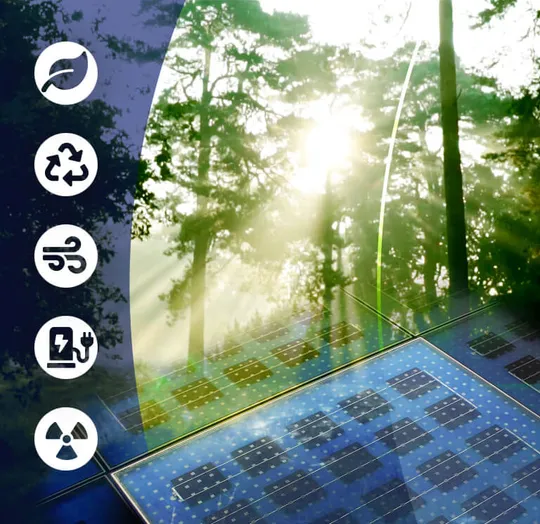
Environmental or clean technology solutions can help to mitigate or reverse the negative effects of human activity on the quality and sustainability of the planet’s environment (water, air, land, biodiversity).
Often green and deep tech go together, as for example in nuclear fusion, lab meat, carbon capture, new battery and electricity storage technologies and agriscience.
The war in Ukraine triggered a serious and unforeseen worldwide food and energy crisis. This accelerated the move away from fossil fuels and unsustainable food production towards a more responsible use of resources. Venture capital innovation is enabling exponential changes in environmentally friendly food and energy production and consumption.
Social impact
Sustainable development
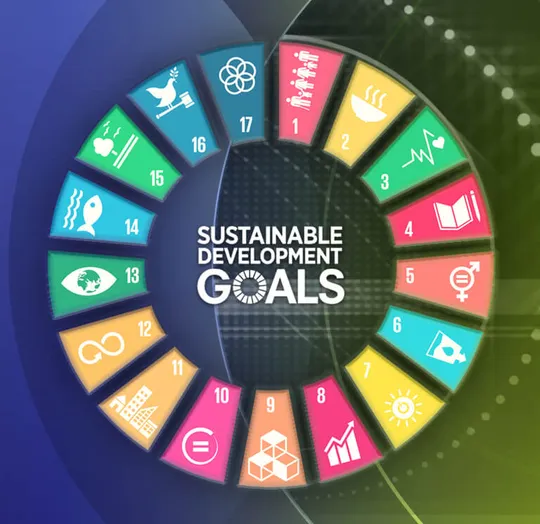
Direct and scalable technology, caring or service solutions which can generate a measurable, beneficial social or environmental impact to society in a sustainable and highly effective way thereby contributing in small but meaningful ways to the achievement of the UN’s 17 Sustainable Development Goals being:
1. No Poverty 2. Zero Hunger 3. Good Health and Well-being 4. Quality Education 5. Gender Equality 6. Clean Water and Sanitation 7. Affordable and Clean Energy 8. Decent Work and Economic Growth 9. Industry, Innovation and Infrastructure 10. Reduced Inequalities 11. Sustainable Cities and Communities 12. Responsible Consumption and Production 13. Climate Action 14. Life Below Water 15. Life on Land 16. Peace, Justice and Strong Institutions 17. Partnerships for the Goals.

Venture Capital Fund Selection Criteria
Getting past the PAST test
Assuming a venture capital fund based in Western Europe and Africa fits into our investment themes of digitalisation, decarbonisation and impact, we use the PAST acronym to describe our approach to analysing and deciding on a commitment.
P = People: 1. Team: composition, personalities, skills, leadership, motivation, commitment (time and money) 2. Track record as a fund manager, entrepreneur, founder or angel investor 3. Quality of investors and advisors 4. Communication with investors: open, honest, constructive and timely.
A = Access: 1. Access to quality deal flow through reputation, referrals and networks 2. Deal sourcing approach and process: IT, marketing, profiling.
S = Strategy: 1. Sector, technology, stage, geography, ticket, process 2. Target portfolio: composition, returns, impact, measurement, support.
T = Terms: 1. Fund size, management fee, carried interest and hurdle rate 2. Governance, reporting and alignment of interests as set out in the limited partnership agreement (LPA).
Investments in 23 Venture Capital fund platforms since 2016

Micro VC funds Europe
Social impact Europe

Foodtech and agritech

Digital tech

Tech accelerator Africa
Web3 early stage
Climate tech

Digital tech

Climate tech fund of funds
Digital tech secondaries

Software and biotech

High impact entrepreneurs Africa
Digital tech Africa

AI and machine learning

Blockchain start ups
Foodtech and climate tech

Tech start-ups Africa

Venture platforms

Climate tech

Climate tech

Deep tech angel investing

Climate tech accelerator

Digital tech
27 Direct Investments since 2005, of which 12 in the current portfolio

Laser-induced nuclear fusion energy

E-mobility Africa

Charging stations E-cars

Power chips E-cars

E-retrofit buses and trucks

Industrial 3D printing

Telco – VOIP B2B

Telco – MVNOE B2B

Telco/Fibre – B2B cloud services

Telco – MVNO B2B

Telco – MVNO B2C

Remote desktop software

Private schools
Private Kindergarten

Fresh sustainable sushi

Lab cultured meat

Natural aromatherapy

Organic skin care

Bioengineering

Medical practices as a service

GP healthtech

Brain imaging software

Automated intralogistics
Automated intralogistics

Solar home energy Africa

E-commerce Africa

Sportswear brands Africa